Glossary
This glossary serves as a clarification of different commonly used terms.
Agile
Source: Agile Alliance, 2001An iterative project management methodology focused on short development cycles, collaboration over documentation, and changing requirements on the fly.
In 2001, in a Waterfall-dominated software development landscape, the Agile Manifesto set out four principles for the production of lean, functioning software. It promotes collaboration, short iterative development cycles, and changing requirements on the fly in response to changing realities. In a nutshell, Agile poses that things can't be predicted up front, and favours team communication over manager mandates (Agile Alliance, 2001).
Design Thinking
Source: Design Council, 2019A methodology for design, focused on creating products that are desirable for the user, business-viable, and technologically feasible to create.
In the 70s and 80s the term Design Thinking was coined to describe the way a designer's mind works as they design (Kimbell, 2011) and with it came many models describing the idealised design process. The most popular Design Thinking model is the Double Diamond, invented by the Design Council (2019) and later improved upon by Hyper Island alumnus Dan Nessler (2016). The Double Diamond consists of four phases, split into two sets of divergent- and convergent thinking: Discover and Define, Develop and Deliver. The first set explores the problem space, the second explores solutions and delivers the correct one to the client.
![Double Diamond process, original by ,[object Object],, adapted by ,[object Object]](/images/double-diamond.png)
IMGD
Source: Wheelan, 2010Integrative Model of Group Development. A model that visualise the 4 stages a team goes through on their way to performance.
Wheelan theorised (2010) four different stages that any group progresses through on their way towards frictionless collaboration. The first stage is about getting to know each other, people look towards a leader for guidance. In Stage 2 that status quo starts to be challenged as people start defining goals and fighting for them. Stage 2 is not necessarily pleasant, but a necessary step towards Stage 3, where the differences have been overcome and trust, structure, and roles are defined. In Stage 4 the different goals are engrained in the team to a point where the team can perform and decide collectively without discussion. Not many teams reach Stage 4, and teams can fluctuate between different stages.
![Figure: Integrative Model for Group Development. Original by Wheelan ,[object Object]](/images/IMGD.png)
Kanban
Source: Aston, 2019A concrete process implementation of Lean principles, focused on visualising workflow through a Kanban board.
Kanban is a concrete implementation of Lean principles. It has less prescriptive processes to follow than Scrum, you can use its tools however makes sense to you. Kanban aims to visualise the workflow, reduce work-in-progress, and shorten the time it takes to deliver a feature. Kanban's main tool is the Kanban board: a list of tasks separated into categories that represent the tasks' status. Team members assign themselves a task and move it on the board as its status changes. This visualises the collective workflow and allows you to track how long each task is worked on.
![Example of a Kanban board ,[object Object]](/images/kanban.png)
Lean
Source: Krafcik, 1988An iterative project methodology focused on delivering the most value to the customer in the least wasteful way.
In the 1930s Toyota started producing cars, and they developed a set of principles to keep the manufacturing process streamlined (Ōno, 1988). These principles would later become known as Lean manufacturing (Krafcik, 1988). The Lean mindset focus on eliminating waste in all its forms, in an effort to continually focus on delivering the most value to the customer in the least wasteful way. Lean manufacturing would inspire others. Lean Startup (Ries, 2011) applies Lean principles to young (digital) companies. Jeff Gothelf's Lean UX (2013) applied these principles to the field of experience design.
MBTI
Source: Myers & Briggs Foundation, 2019Myers-Briggs Type Indicator. A widely-used framework for classifying people into 16 different personality types.
The MBTI is made up of four different axes. A person fills in a list of questions, to score themselves on the different axes and determine the final personality type.
- Extraversion – Introversion: where you get your energy from
- Sensing – Intuition: how you prefer to learn & believe in new information
- Thinking – Feeling: on what basis you make decisions
- Judging – Perceiving: how you prefer to act on information
The MBTI is widely used in team evaluations, but should not be taken as an absolute truth. After all, human psychology is more complex than 16 personality types.
PRINCE2
Source: ILX Group, 2017A linear project management methodology focused on providing justification up front.
PRINCE2 is the most widely used linear methodology today. It was released by the UK government in 1996 as a generic project management framework after starting life in 1975 as PROMPT, developed to make large IT projects manageable (ILX Group, 2017). PRINCE2 places emphasis on justification: nothing should be left up to chance to prevent unnecessary work. A PRINCE2 project is divided in distinct phases and has clear roles and responsibilities (ILX Group, n.d.). While its strict principles are great for large-scale projects, it causes a lot of overhead for smaller teams.
![Visual illustration of PRINCE2 components ,[object Object]](/images/prince2.jpg)
Pomodoro
Source: Cirillo, 2018A time management technique in which you work in chunks of 25 minutes, followed by 5 minutes of rest.
Pomodoro is especially useful for difficult or complicated tasks, as it asks you to concentrate for "only" 25 minutes at a time, and rewards you accordingly. The idea is that each pomodoro is dedicated to one specific task so that you don't get distracted by multiple things. After 4 pomodoro's a large break (of about 30 minutes) is held, and the cycle starts over.
SDI Triangle
Source: Porter, 1973The Strength Deployment Inventory Triangle. A self-discovery tool to visualise someone's personal strengths in relating to others.
The SDI Triangle consists of three corners, each with a colour:
- Red: Assertive. Red people are focused on team performance, reaching goals. They are good at persuading people and taking risks if necessary, but can be competitive and commanding.
- Green: Analytical. Green people are concerned with structure and proof. They are objective and meticulous, but can be (too) cautious.
- Blue: Altruistic. Blue people want to develop and protect the people around them. They are modest, loyal and supportive, but can be (too) selfless and emotional.
Each person is a mix of all three colours, and the degree of each differs depending on the amount of stress that someone is experiencing. Placing oneself on the triangle and discussing the placement can be a great way of getting to know oneself and teammates.

Scrum
Source: Aston, 2019A concrete process implementation of Agile principles, prescribing special roles and meetings to manage short development cycles, constant communication, and reflection.
Scrum is the most widely used Agile implementation: it provides a "recipe to become agile". It defines a number of special roles, special meetings (called scrum ceremonies) and tools to divide work (Aston, 2019). In Scrum, small autonomous teams work to solve items in a backlog. A scrum master is responsible for the scrum process and a product owner is responsible for the end solution. Work is divided into cycles of 2-4 weeks called sprints. The result of each sprint should be a functioning piece of software to be reviewed by the client. Daily standups let employees discuss what they're working on, and retrospectives reflect on the previous sprint to improve the next one (Aston, 2019). Scrum is great for big projects with changing requirements, but can be a lot of process to manage for a small team, so often only parts of Scrum's methodology are used.
VUCA
Source: Kraaijenbrink, 2018Volatility, Uncertainty, Complexity, and Ambiguity. A term used to describe the growing complexity of the world and, in particular, business processes.
VUCA is an acronym of four interrelated terms:
- Volatility: The speed with which things change. This is the result of the quicker pace of the world: short delivery times, internet speed, travel times, globalisation, and more.
- Uncertainty: How well you can predict a situation. The amount of players in a market or changing customer behaviour can make it hard or impossible to predict what outcome a decision will have.
- Complexity: The amount of factors at play.This depends on the size and variety of the system and the interconnectedness of different things part of the system.
- Ambiguity: What something means. Information that is incomplete, contradicting or inaccurate makes it difficult to draw conclusions based upon it.
The modern world is harder to understand and control because of these four aspects being more and more difficult. In various definitions, the latter two are even proposed to be a result of the former two: the more volatile and complex a situation, the more uncertain and ambiguous we perceive it
Waterfall
Source: Royce, 1970A concrete process implementation of PRINCE2 principles, focused on pre-planning and executing in linear stages.
In a Waterfall project the entire solution is described at the start in requirements that are as specific as possible. All the work needed to execute the solution from start to finish is planned out and then executed in predefined stages of design, implementation and testing. Each stage needs to be fully completed and agreed upon as each stage builds on the one before (Royce, 1970). Waterfall can be a great methodology for short projects with fixed requirements, but it's often criticised for its lack of reflection, revision, and client involvement (Petersen, Wohlin and Baca, 2009). Especially for design projects, which often deal with wicked problems (Buchanan, 1992), it's difficult to pre-plan the entire solution.
Emotional intelligence
Source: Goleman, Boyatzis and McKee, 2013A person's understanding of their own- and other people's emotions, and the ability to appeal to other people's emotions.
Our emotional system is an open loop system: it relies on input from people around us to function. This makes us dependent on the presence of people around us to remove stress and improve performance. A group’s emotional leader sets the emotional direction. The emotional leader and the formal leader don’t have to be the same person. When people feel good they work at their best: it enhances creativity, persistence, and cooperation.
There are four categories of emotional intelligence competencies: self-awareness, self-management, social awareness, and relationship management. Great leaders typically have strengths in ~6 of them. There’s no fixed formula or style for great leadership, but typically leaders have at least 1 strength is each of the domains.
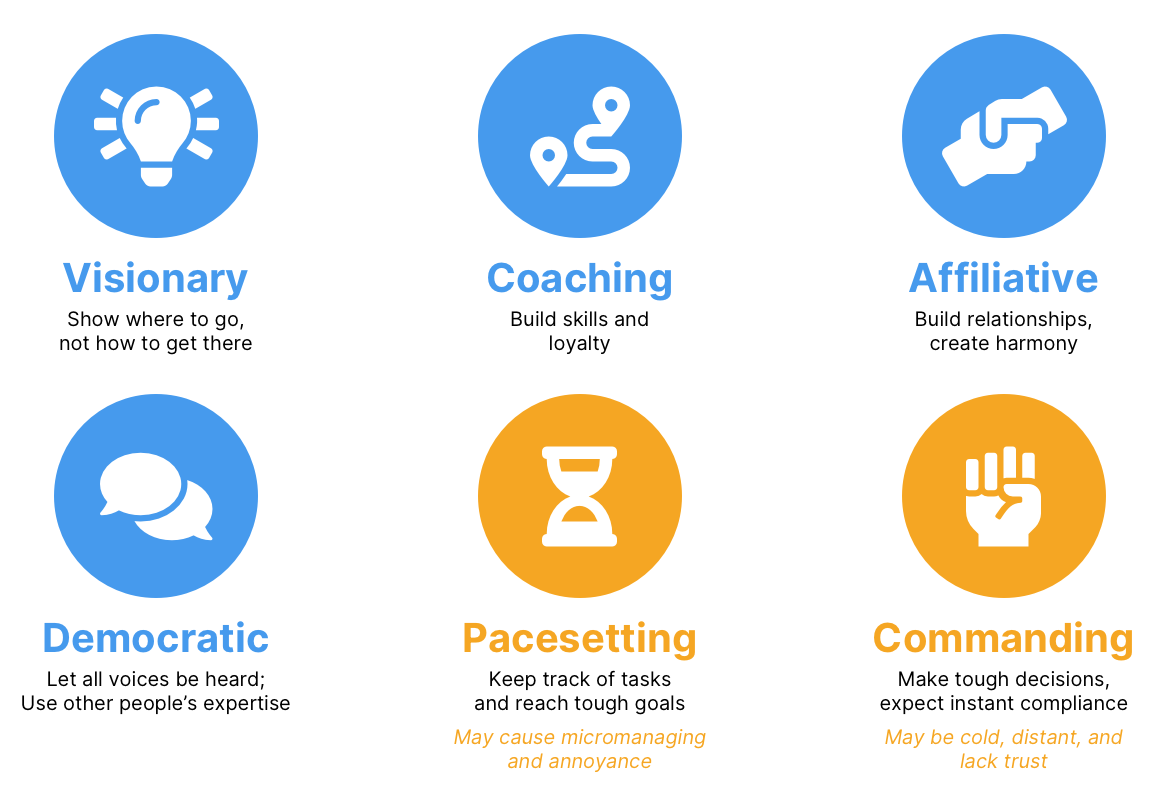
These competencies culminate in 6 leadership styles. The most effective leaders act according to one or more of 6 distinct leadership styles, switching between them on the fly. The first four create resonance and boost performance, the last two should be used carefully in specific situations.
Group flow
Source: Sawyer, 2015A collective state of mind in which a group can act together without thinking or discussing, as actions become spontaneous.
Mihaly Csikszentmihalyi (Csikszentmihalyi, 1991) coined the term flow to describe a state of heightened consciousness. People describe flow state as a sense of competence and control, a loss of self-consciousness, and losing track of time. Groups who work together and improvise on the spot can reach this same flow state as a collective. Group flow occurs when many tensions are in perfect balance: Just enough familiarity and structure to understand each other and feel safe, but also enough freedom and risk to perform creatively. Reaching group flow is easier within a small team of people who are greatly attuned to one another.
Groupthink
Source: Ethics Unwrapped, 2013The phenomenon where team members prioritise maintaining group harmony over making the best decisions.
Groupthink is a type of cognitive bias related to our desire to fit in and stay loyal to a group, so much so that we convince ourselves that the decisions made are better than they are when evaluated outside of a group context. This can lead to suboptimal or even unethical decisions.